How Agentic AI Changes Threat Detection in 2026
How agentic AI can help with investigation, correlation and learning loops without removing human approval for consequential response.
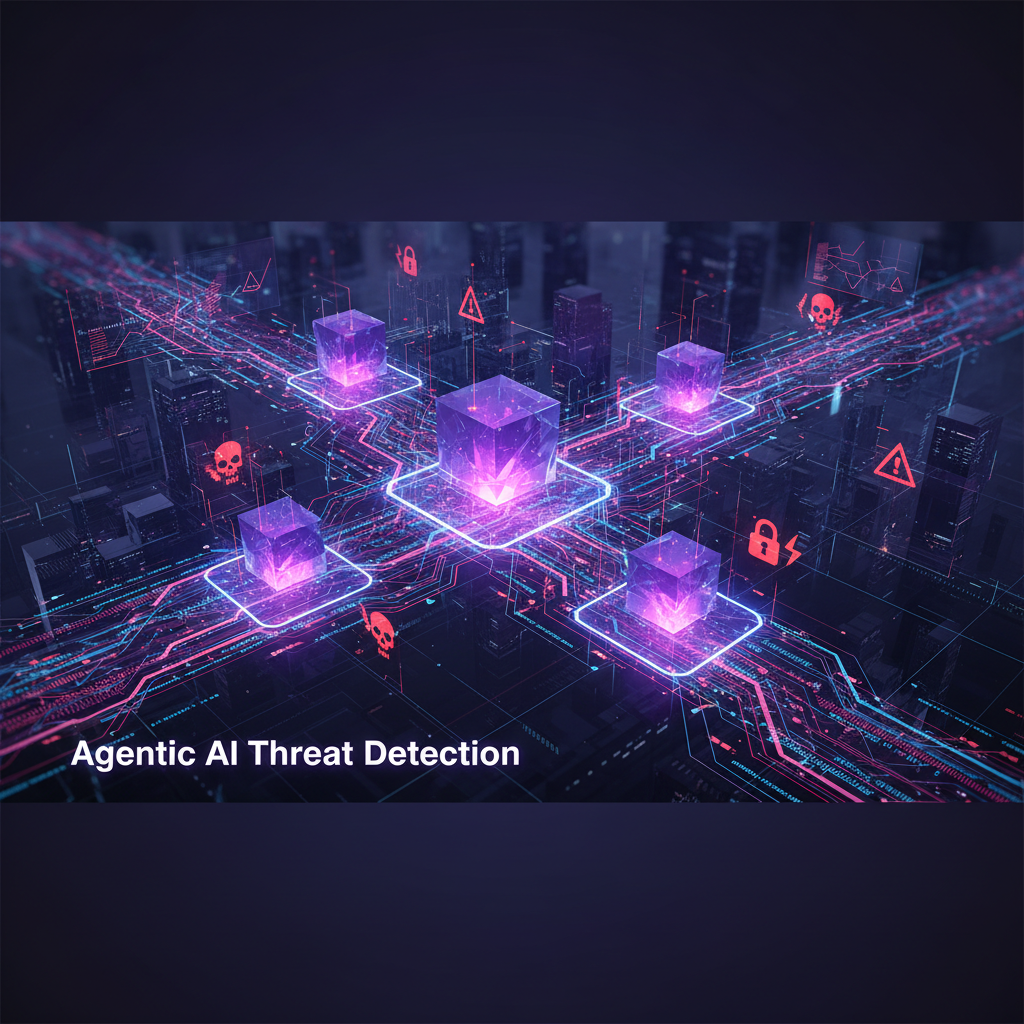
The Threat Detection Challenge
Modern security teams face an impossible task: analyzing millions of events daily to identify the handful of genuine threats hidden among countless false positives. Traditional SIEM and detection tools generate so much noise that critical alerts are often missed or delayed.
The numbers are staggering:
- Average SOC receives 10,000+ alerts per day
- Only 15-20% are investigated due to resource constraints
- Mean time to detect a breach: 207 days (IBM 2025 Data Breach Report)
- Security teams spend 40% of their time on false positives
Enter Agentic AI
Agentic AI systems represent a breakthrough in threat detection by combining:
- Autonomous reasoning - AI agents that can independently investigate alerts
- Contextual analysis - Understanding of normal vs. anomalous behavior
- Multi-signal correlation - Connecting dots across disparate data sources
- Adaptive learning - Continuous improvement from every incident
How Agentic AI Detects Threats Differently
Traditional Detection: Rules and Signatures
Traditional systems rely on:
- Pre-defined rules ("if X happens, then alert")
- Known threat signatures
- Static thresholds and baselines
- Limited context about user/system behavior
Result: High false-positive rates and missed novel attacks.
Agentic AI Detection: Behavioral Intelligence
Agentic systems build dynamic behavioral models:
Normal User Profile:
├── Login patterns (time, location, device)
├── Data access patterns (what, when, volume)
├── Network behavior (destinations, protocols)
└── Application usage (typical workflows)

Anomaly Detected:
├── Login from unusual location
├── Access to rarely-used data
└── Large data download

Agentic Investigation:
├── Cross-reference with:
│   ├── Recent HR events (departures, role changes)
│   ├── Threat intelligence (compromised credentials)
│   ├── Related user behaviors
│   └── Similar historical incidents
└── Risk assessment: HIGH - Potential data exfiltration
Real-World Detection Scenarios
Scenario 1: Advanced Persistent Threat (APT)
Traditional Detection:
- Weeks or months to detect
- Relies on known IOCs
- Misses low-and-slow techniques
Agentic AI Detection:
- Notices subtle changes in network traffic patterns
- Correlates with unusual authentication behaviors
- Identifies lateral movement attempts
- Builds attack timeline automatically
- Contains threat within hours
Time to detect: Reduced from weeks to hours
Scenario 2: Insider Threat
Challenge: Legitimate credentials, authorized access, subtle indicators
Agentic AI approach:
- Establishes baseline for each user's normal behavior
- Detects deviations (unusual data access, time of activity, volume)
- Correlates with contextual signals (upcoming departure, financial stress indicators)
- Flags for investigation before exfiltration occurs
Impact: Prevents data loss rather than detecting it after the fact
Scenario 3: Supply Chain Attack
Complexity: Legitimate software behaving maliciously
Agentic AI detection:
- Monitors application behavior for unexpected changes
- Correlates across multiple organizations (threat intelligence)
- Identifies zero-day exploitation patterns
- Automatically isolates affected systems
- Provides forensic timeline for incident response
The Agentic AI Detection Workflow
Phase 1: Continuous Monitoring
AI agents continuously observe:
- Network traffic and communications
- User authentication and access patterns
- Endpoint behaviors and system calls
- Application logs and database queries
- Cloud resource usage and configurations
Phase 2: Intelligent Triage
When an anomaly is detected:
- Risk scoring - Immediate assessment of threat severity
- Context gathering - Automatic enrichment with relevant data
- Historical comparison - Check against known patterns
- Related signal search - Look for correlated indicators
Phase 3: Autonomous Investigation
For medium-risk alerts, AI agents:
- Query additional data sources
- Check threat intelligence feeds
- Examine user/device history
- Assess potential blast radius
- Determine if action is needed
Low risk → Auto-close with documentation Medium risk → Contain and alert analyst High risk → Immediate escalation + automated containment
Phase 4: Continuous Learning
After each incident:
- Feedback integration - Learn from analyst decisions
- Pattern refinement - Update behavioral models
- Detection tuning - Reduce false positives
- Playbook evolution - Improve response automation
Measuring Detection Effectiveness
Key Metrics
Before Agentic AI:
- Alert volume: 10,000+ daily
- False positive rate: 45%
- MTTD: 207 days (average breach)
- Investigation time: 30-45 minutes per alert
- Alerts investigated: 20%
After Agentic AI:
- Alert volume: 150-200 high-priority (98% reduction)
- False positive rate: 8%
- MTTD: Hours to days (80%+ improvement)
- Investigation time: 5-10 minutes (AI-assisted)
- Alerts investigated: 95%+
ROI Calculations
For a mid-sized enterprise:
- Analyst time saved: 1,200 hours/month
- Cost avoidance: $850K/year (reduced breach impact)
- Efficiency gain: 5x increase in threats detected per analyst
Implementation recommendations
1. Start with High-Value Use Cases
Don't try to automate everything. Begin with:
- Credential compromise detection
- Data exfiltration prevention
- Lateral movement detection
- Malware behavior analysis
2. Establish Training Baselines
Agentic AI needs quality data:
- 30-90 days of normal behavior
- Labeled historical incidents
- Threat intelligence integration
- Clear false-positive feedback
3. Define Automation Boundaries
Set clear rules for autonomous actions:
- Auto-contain: Known malware, confirmed C2 communication
- Alert + recommend: Suspicious user behavior, unusual access
- Escalate immediately: Potential data breach, APT indicators
4. Build Feedback Loops
Enable continuous improvement:
- Analyst feedback on AI decisions
- Regular model performance reviews
- Tuning sessions based on missed detections
- Playbook refinements
Challenges and Considerations
Data Quality Requirements
Agentic AI is only as good as its data:
- Complete log collection across all sources
- Consistent data normalization
- Accurate asset and user inventories
- Clean, labeled training datasets
Explainability and Trust
Security teams must understand AI decisions:
- Transparent reasoning chains
- Clear evidence presentation
- Confidence scores for recommendations
- Audit trails for compliance
Integration Complexity
Effective agentic AI requires:
- Integration with SIEM, EDR, firewall, IAM systems
- API access to threat intelligence platforms
- Orchestration with existing security tools
- Change management for new workflows
The Path Forward
Agentic AI isn't replacing security analysts—it's multiplying their effectiveness. By automating the tedious work of alert triage and initial investigation, AI agents free human experts to focus on:
- Strategic threat hunting
- Complex incident response
- Security architecture improvements
- Earlier defense planning
As threat actors increasingly leverage AI for attacks, defenders must embrace agentic AI for detection. The question isn't whether to adopt agentic detection, but how quickly you can implement it to stay ahead of evolving threats.
Start with one painful detection workflow. Measure the current queue, define human approval points, then automate the repeatable investigation steps.